Project Sponsor
Holds budget sign-off, risk appetite, and the executive relationship with the board. Wants the outcome; doesn't want surprises.
Risk: High influence, rarely in the room — assumptions about their position are dangerous.
MULTIPLAYER SIMULATION · 6 ROLES · UP TO 36 PLAYERS
A multiplayer simulation where every stakeholder in the room wants something different — and you need all of them to say yes.
Quick answer
66%
of projects fail due to inadequate stakeholder engagement (PMI)
2.3×
more likely to miss timelines when stakeholder alignment isn't established early
Q3
is when most stakeholder crises surface — long after Q1 decisions locked them in
Every project has a room full of people who were never asked the right question. This simulation is that room.
Most stakeholder management training teaches a framework. Map your stakeholders. Rate power vs. interest. The framework is sound — but it's often done in a spreadsheet, alone, before anyone has said anything difficult in the room.
Stakeholder Management puts six people in role, each holding a different agenda and real decision-making power. The situation isn't resolved by the right framework. It's resolved by how you read the room, how you build the case, and what you're willing to trade.
Structured phases keep energy and learning tight — from brief through play to debrief.
Phase 1
Six stakeholders receive their briefs with different objectives and success criteria. None know exactly what the others hold. The simulation begins before the first vote — in what each person chooses to reveal.
Information asymmetry
Phase 2
Structured time for bilateral conversations. Who do you need? What do you trade? The team that wins the vote often built the majority before the meeting started.
Negotiation + alliance-building
Phase 3
The proposal goes to a vote. Positions are visible to all. Then the debrief: what drove each decision, what was missed, and what would change.
Resolution + accountability
Consequence: Transparent; may slow the steering committee but preserves trust with finance.
Consequence: If the CFO discovers the discrepancy in Q3 reporting, trust in the project lead drops and the sponsor may distance themselves.
Consequence: Buys alignment time; shows respect for finance — often the highest-ROI path.
Holds budget sign-off, risk appetite, and the executive relationship with the board. Wants the outcome; doesn't want surprises.
Risk: High influence, rarely in the room — assumptions about their position are dangerous.
Holds the financial model and the long memory of what was promised last year.
Risk: Must be won over with data before the meeting, not managed in the room.
Holds success criteria and the relationship. Has non-negotiables that were never written down.
Risk: Will disengage if they feel managed rather than consulted.
Holds execution reality — which timelines are feasible and which are political.
Risk: Will torpedo the vote if the plan ignores ground-level constraint.
Holds the rules nobody reads until something goes wrong.
Risk: Low voice, high veto — easy to forget to include.
Nominally an ally — holds political capital and uses it carefully.
Risk: If you don't protect their position, they won't protect yours.
Live feedback makes trade-offs visible — so debrief uses data, not impressions alone.
Stakeholder alignment score
0–100
Coalition strength
% of votes secured pre-meeting
Information coverage
Shared vs. held back
Influence budget
Points spent vs. remaining
Tells everyone everything. Loses leverage through transparency — trusted, but often outmanoeuvred.
Hoards information. Strong position, weak relationships — may win the vote but lose the next three.
Trades strategically — wins more than they lose with a replicable pattern.
Responds bilaterally without a plan — coalitions get built by others.
When competing teams share a fleet and nobody feels the constraint until it's late.
View simulation →Combine framework with live simulation in one programme arc.
View simulation →Client expectations vs. internal targets — decisions under pressure.
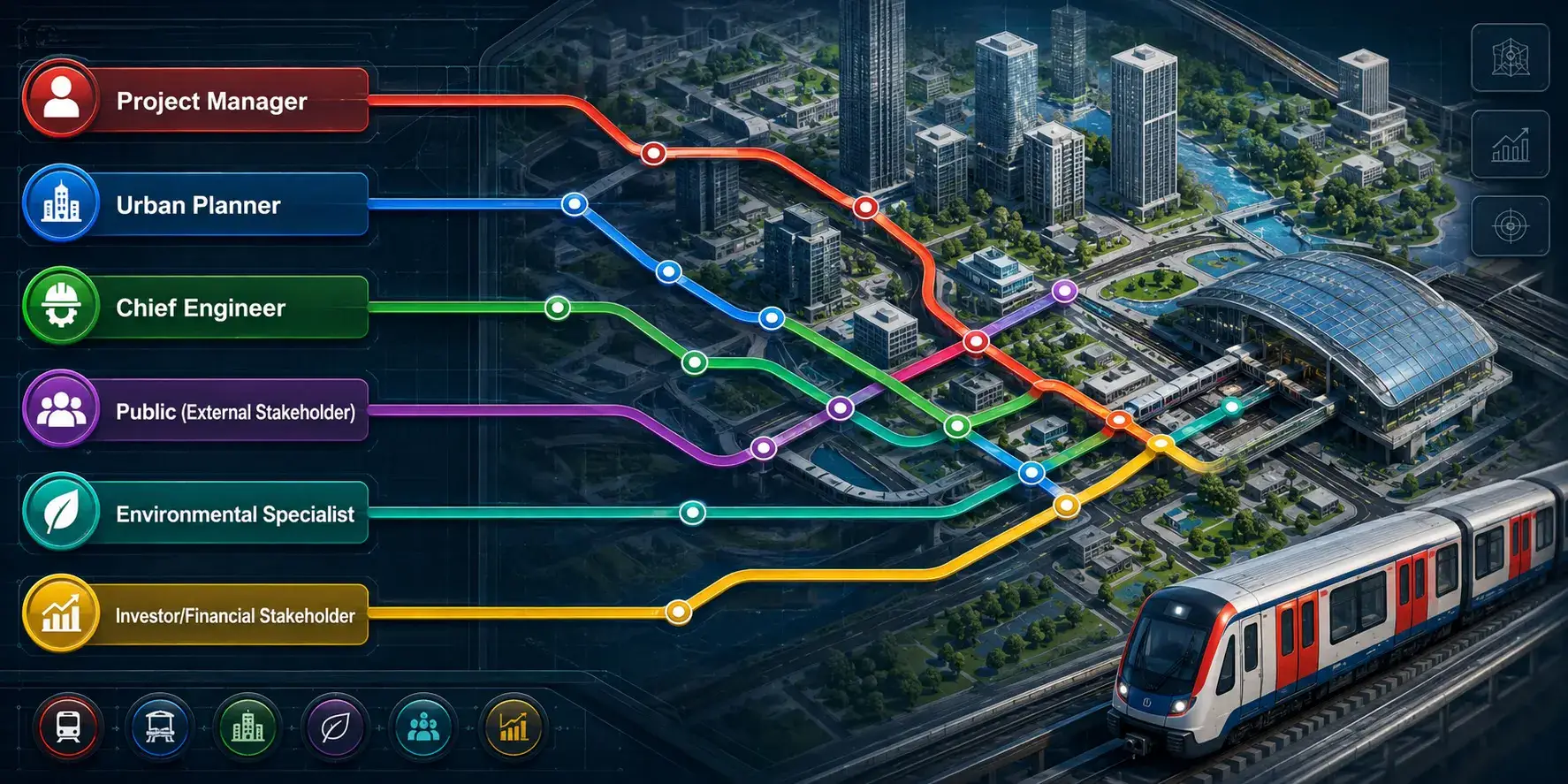
View simulation →A facilitated Metro Stakes scenario where leaders manage multiple stakeholders with conflicting priorities, incomplete information, and visible reputational stakes. Decisions update influence maps and project health.
Stakeholder mapping, coalition building, transparent communication under pressure, and knowing when to escalate versus negotiate — mapped to competency indicators in debrief.
Senior managers, programme leads, and transformation teams operating in matrixed organisations — especially before major governance or steering-committee cycles.
Book a facilitated session — we'll match group size, format, and outcomes to the right simulation.